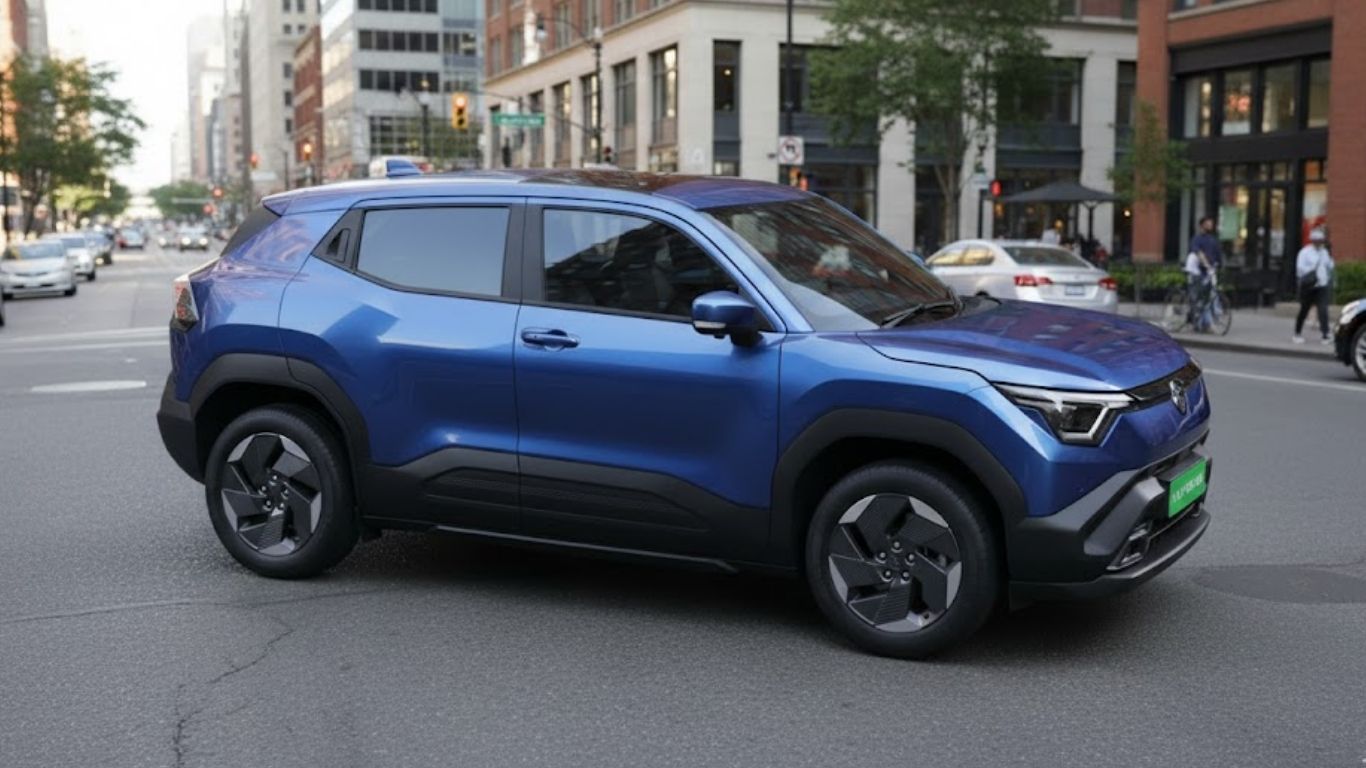
Maruti Suzuki e Vitara price without BaaS is finally out, and interestingly, the electric SUV looks far more competitive than many expected. While the company earlier announced pricing under the Battery-as-a-Service (BaaS) model, it has now revealed the full ex-showroom prices including the battery cost. As a result, buyers can clearly compare both ownership models and make an informed decision. Moreover, with introductory pricing valid till March 31 and a complimentary home charger included, the e Vitara strengthens Maruti Suzuki’s entry into India’s fast-growing EV segment.
Maruti Suzuki e Vitara Price Without BaaS in India
Maruti Suzuki India Limited has officially disclosed the complete price list of the Maruti Suzuki e Vitara without the Battery-as-a-Service program. Unlike the rental-based model, these prices include the full battery cost upfront, which many long-term buyers prefer.
Here’s the variant-wise ex-showroom pricing:
| Variant | Battery Pack | Price (Ex-Showroom) |
|---|---|---|
| Delta | 49 kWh | Rs 15.99 lakh |
| Zeta | 61 kWh | Rs 17.49 lakh |
| Alpha | 61 kWh | Rs 19.79 lakh |
Additionally, customers choosing the dual-tone colour option will need to pay a premium of Rs 21,000. However, Maruti is currently offering these as introductory prices valid until March 31, which makes early booking financially beneficial. Moreover, the company is also providing a complimentary home charger along with installation, reducing the initial setup cost for EV buyers.
Maruti Suzuki e Vitara BaaS Pricing Explained
Earlier, the brand introduced pricing under the Battery-as-a-Service (BaaS) model to make EV ownership more affordable. Under this structure, customers pay a lower upfront vehicle price and instead pay a battery rental fee per kilometre.
| Variant | Battery Pack | Price (Ex-Showroom) | Battery Rental |
|---|---|---|---|
| Delta | 49 kWh | Rs 10.99 lakh | Rs 3.99/km |
| Zeta | 61 kWh | Rs 11.99 lakh | Rs 4.39/km |
| Alpha | 61 kWh | Rs 14.29 lakh | Rs 4.39/km |
Therefore, buyers who drive less annually may find the BaaS option financially attractive. On the other hand, high-mileage users could benefit more from purchasing the battery outright. Consequently, Maruti has smartly provided flexibility to cater to different driving patterns.
Maruti Suzuki e Vitara Battery, Range and Performance
The e Vitara comes with two battery pack options — 49 kWh and 61 kWh — and both variants feature a front-wheel-drive (FWD) layout. Meanwhile, the larger 61 kWh battery delivers an ARAI-certified range of up to 543 km, which positions it strongly in the segment. As a result, range anxiety should not be a major concern for city as well as occasional highway users.
The Delta trim gets the smaller 49 kWh battery, whereas the Zeta and Alpha trims come equipped with the bigger 61 kWh unit. Moreover, Maruti Suzuki has tuned the powertrain to deliver smooth acceleration and efficient energy management, ensuring a practical everyday driving experience.
Maruti Suzuki e Vitara vs Rivals: Price Comparison
Interestingly, the introductory pricing gives the e Vitara a clear edge over several established electric SUVs in India. While competitors offer strong features, they are priced noticeably higher in many cases.
| Model | Starting Price (Ex-Showroom) |
|---|---|
| Hyundai Creta Electric | Rs 18.02 lakh |
| MG Windsor EV | Rs 15.49 lakh |
| Mahindra BE6 | Rs 18.90 lakh |
| Tata Curvv EV | Rs 17.49 lakh |
Compared to the Hyundai Creta Electric and Mahindra BE6, the e Vitara undercuts them significantly, especially under the BaaS model. Furthermore, even when purchased without BaaS, its pricing remains competitive against the Tata Curvv EV. Therefore, Maruti Suzuki has strategically positioned the e Vitara as a value-focused electric SUV.
Should You Buy the Maruti Suzuki e Vitara Without BaaS?
If you plan to keep the vehicle for several years and drive extensively, buying the e Vitara without BaaS may prove more economical in the long run. However, if you prefer lower upfront costs and flexible usage-based payments, the BaaS model could suit you better. Additionally, with Maruti Suzuki’s widespread service network and growing EV infrastructure, ownership confidence increases significantly.
Overall, the Maruti Suzuki e Vitara marks a serious entry into India’s electric SUV market. Moreover, with competitive pricing, practical range, and flexible ownership models, it directly targets mainstream buyers transitioning to electric mobility. Consequently, it could emerge as one of the most accessible electric SUVs in 2026.